


KEEP ON DANCEING ENTERTAINMENT
Get in touch with us at info@new.com




Best Radio Station 2019 to 2026
A German / Afrikaans Radio Station in Germany
19 Servers Worldwide







Limburg an der Lahn
Bundesland |, Hesse
Limburg an der Lahn, with its striking Gothic Cathedral, the narrow alleys of the Altstadt and the charming Fachwerkhäusern, radiates a mittelalterliche atmosphere, the Besucher in the Geschichte der Stadt eintauchen lässt.
Welcome to Limburg an der Lahn, a city that captivates visitors with its winding alleyways, the idyllic Lahn River, and remarkable buildings like Limburg Cathedral. This Hessian cathedral city lies on the western border of the state, nestled between the Taunus and Westerwald mountain ranges, and offers an ideal base for day trips.
Old Town Half-timbered Houses at the Kornmarkt in Limburg
Limburg's Old Town is like a living history book, taking visitors on a fascinating journey through the centuries. Half-timbered houses, Gothic churches, and charming squares tell the story of the city's rich past.
The half-timbered houses at the Fischmarkt (Fish Market): A picturesque setting that invites you to stroll and linger. These historic buildings bear witness to the craftsmanship of centuries past.
The Bishop's Palace: An imposing building that once served as the residence of the Bishop of Limburg and now houses a museum offering insights into the history of the city and its inhabitants.
Other notable buildings in the Old Town:
Werner Senger House Old Coffee Roastery Roman House Zum Goldenen Hirschen (At the Golden Stag) Werner Senger House dating from 1250 The House Zum Goldenen Hirschen (At the Golden Stag) on the Kornmarkt (Grain Market) Unique half-timbered houses as far as the eye can see At the Fish Market in the Old Town A stroll through the winding lanes of the Old Town is definitely worth taking a camera to capture the unique historical architecture.
Cathedral Square Cathedral Square, with St. George's Cathedral, towers over Limburg's Old Town and is arguably the city's most popular attraction. With its striking towers, it rises above the city, and its magnificent Gothic appearance is unparalleled in Germany. A visit to the cathedral is an absolute must for anyone interested in religion, history, or architecture. Limburg Cathedral sits idyllically overlooking the Old Town and the Lahn River.
Inside Limburg Cathedral. Limburg Cathedral at sunset over the rooftops of the Old Town. Lahn River Promenade The picturesque Lahn River meanders through the city, offering numerous opportunities for walks and relaxation. The river promenade invites you to stroll along its banks and offers magnificent views of the water and the surrounding landscape. Along the Lahn, you'll also find some of the city's most beautiful sights, including:
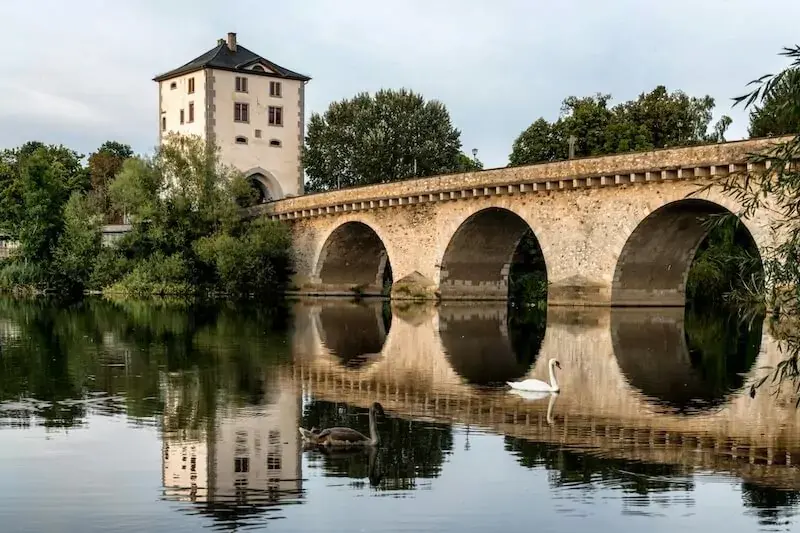
The Lahn Bridge: A historic structure connecting the old town to the opposite bank and offering spectacular views of the city. The Lahn River Trail: A scenic hiking path along the river, perfect for relaxing walks and bike rides, allowing you to experience the natural beauty surrounding Limburg. The old Lahn Bridge invites you to linger by the Lahn. A visit along the Lahn is an ideal way to escape the hustle and bustle of the city and enjoy the peace and tranquility of nature. Other Sights and Activities In addition to the highlights already mentioned, there are many other places worth seeing and activities to enjoy in Limburg an der Lahn:
The Historic Town Hall: An impressive building in the heart of the old town, whose Gothic architecture and distinctive tower make it one of the city's landmarks. Oranienstein Castle: A magnificent Baroque castle perched high above the city, offering breathtaking views of Limburg and the surrounding countryside. The Rose Garden: An idyllic park in the heart of the old town, with its fragrant rose beds and shady spots, perfect for relaxing and unwinding. Whether you are interested in history, culture, or nature, Limburg an der Lahn offers something special for every visitor and is just waiting to be discovered.


Information about Germany: Essential facts summarized briefly and concisely Everything you've always wanted to know about Germany: Here you'll find the most important facts and figures in a nutshell. Geographical/Demographical State How many federal states does Germany have? The Federal Republic of Germany has been a democratic parliamentary federal state since 1949. Since reunification in 1990, Germany has consisted of the following 16 federal states. What are the names of the 16 federal states?
-
Baden-Württemberg
-
Bavaria
-
Berlin
-
Brandenburg
-
Bremen
-
Hamburg
-
Hesse
-
Mecklenburg-Western Pomerania
-
Lower Saxony
-
North Rhine-Westphalia
-
Rhineland-Palatinate
-
Saarland
-
Saxony-Anhalt
-
Saxony
-
Schleswig-Holstein
-
Thuringia
The head of state is the Federal President, and the head of government is the Federal Chancellor.
Germany's largest city is also its capital: Berlin, with 3.4 million inhabitants. Other cities with over a million inhabitants include Hamburg (1.8 million) and Munich (1.3 million), while Cologne falls just short. Frankfurt am Main (662,000) is an international financial center. Germany's landscape is diverse. In the north lie the coasts of the North Sea and the Baltic Sea, while in the south rise the high peaks of the Alps. In between, you'll find a variety of landscapes: agricultural plains, expansive river and lake districts, forested regions, urban centers, and rolling hills. Germany's highest mountain is the Zugspitze, at 2,963 meters. The longest river is the Rhine, which flows for 865 kilometers through Germany. Germany boasts 16 national parks, 104 nature parks, and 18 biosphere reserves, 16 of which are UNESCO Biosphere Reserves.

Life in Germany is characterized by a diversity of cultural influences; it is modern and cosmopolitan. Numerous traditional festivals such as Carnival, wine festivals, and Oktoberfest, music festivals ranging from classical to rock, and excellent cuisine, complemented by wines from the 13 wine-growing regions, invite people to enjoy convivial gatherings.
Deutschland ist die Heimat großer Dichter und berühmter Musiker. Namen wie Goethe und Günter Grass, Bach und Beethoven zeugen von der langen Tradition einer hochkarätigen Kulturszene. Heute präsentiert sie sich in Deutschland in einer schillernden Vielfalt von modern bis antik. Es gibt etwa 300 Theater und 130 Berufsorchester, 630 Kunstmuseen mit international bedeutenden Sammlungen. Literatur und Film sind Sparten, in denen deutsche Künstler jedes Jahr viel Kreatives schaffen.
Auch die Wissenschaft und bedeutende Bildungs- und Forschungseinrichtungen sind in Deutschland fest verankert: Die rund 370 Hochschulen genießen auch bei internationalen Studierenden hohes Renommee.
German missions abroad can be described as Germany's "eyes, ears, and voice." Acting on instructions from the Federal Foreign Office, they represent Germany, safeguard its interests, and protect its citizens in the host country. They negotiate with the local government and promote political relations as well as economic, cultural, and scientific cooperation. Embassies are involved in all areas of foreign relations, including fostering bilateral, especially political, relations; promoting German economic interests; providing assistance to German citizens; and participating in international cooperation in research and technology, social policy, agriculture, and development policy. Unlike embassies, which are responsible for one or more countries, consulates general and consulates have a regionally limited consular district. Their responsibilities primarily encompass legal and consular matters, foreign trade promotion, cultural cooperation, and public relations. Political relations, however, remain the exclusive domain of embassies.